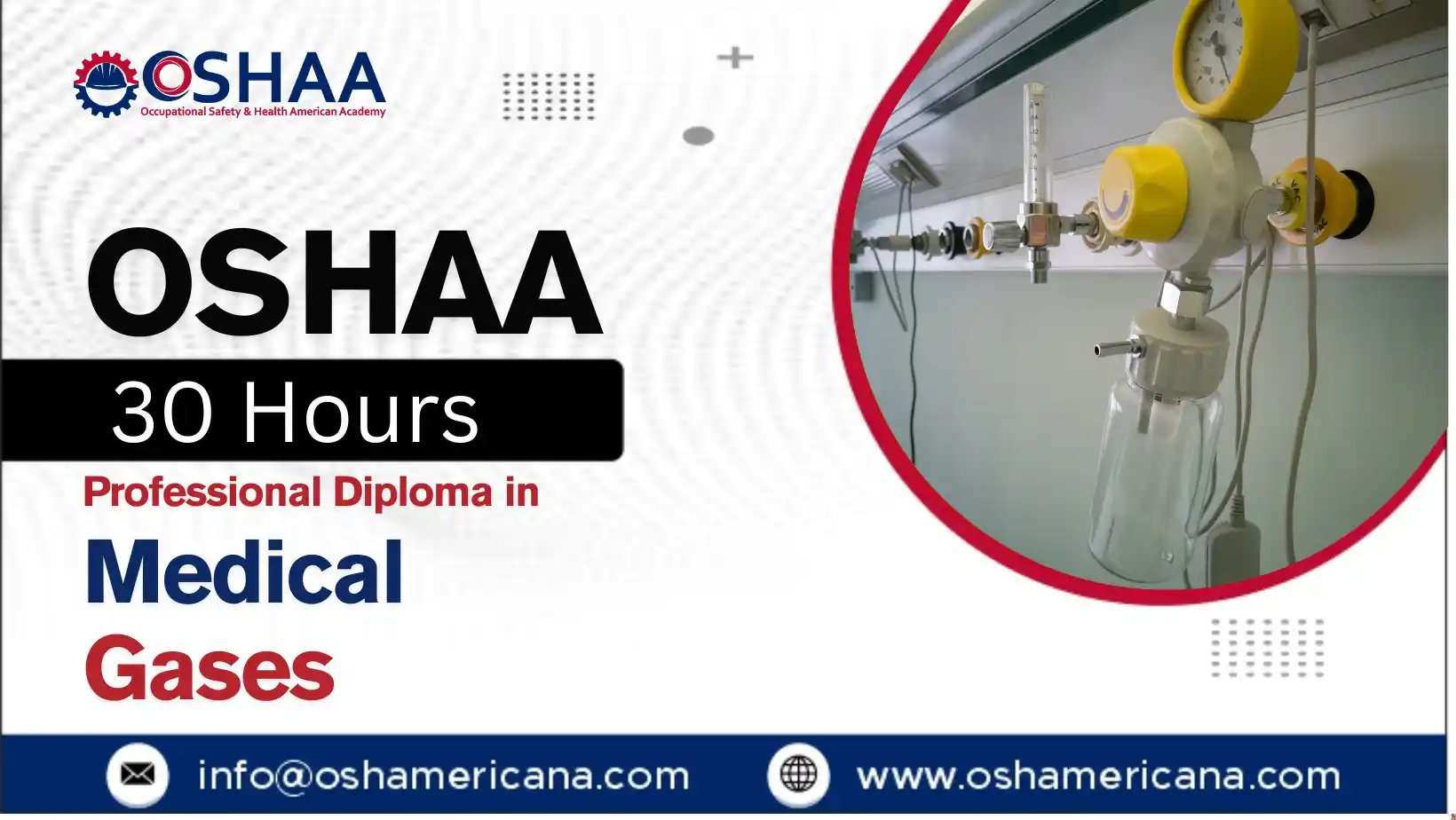
Advance Your Skills with Professional Diploma in Medical Gases
The management and application of medical gases form a critical part of healthcare infrastructure, influencing patient safety, clinical procedures, and hospital engineering. The OSHAA 30-Hours Professional Diploma in Medical Gases has been carefully designed to provide comprehensive knowledge and practical insights into the use, storage, distribution, and safety protocols associated with medical gases in healthcare environments.
Medical gases are vital to patient care and are used across a wide range of clinical services. This diploma introduces participants to the science, classifications, and critical applications of medical gases, while also covering the technical systems used for their distribution and control. Emphasis is placed on health and safety standards, risk management, legal responsibilities, and compliance with healthcare engineering protocols.
Delivered over 30 learning hours, the course integrates theoretical concepts with practical scenarios, providing participants with the confidence to understand and operate medical gas systems effectively in clinical environments.
Upon completion, participants can pursue advanced roles in hospital engineering, health and safety consultancy, or healthcare facility management. The diploma also lays the groundwork for progression into further specialisations such as medical gas design, health technology assessment, or advanced clinical engineering qualifications.
OSHAA 30-Hours Professional Diploma in Medical Gases
- Age: 18 years or older
- Education: High school diploma or equivalent; prior healthcare or technical training is advantageous but not mandatory
- Language: Proficiency in English to understand technical materials, safety procedures, and regulatory guidelines
- Experience: No prior work experience is required, though exposure to clinical or hospital environments is beneficial
Study Units
Learning Outcomes
Introduction to Medical Gases and Their Clinical Applications (3 hours)
- Understand the role and importance of medical gases in various healthcare settings
- Identify the common medical gases used in clinical procedures
- Recognise the basic principles of gas delivery systems and patient applications
Classification and Properties of Medical Gases (3 hours)
- Distinguish between different types of medical gases and their classifications
- Describe the physical and chemical properties of medical gases
- Understand the implications of gas properties for storage, handling, and clinical use
Medical Gas Pipeline Systems: Design and Operation (4 hours)
- Explain the structure and function of medical gas pipeline systems
- Identify key components such as manifolds, outlets, and alarm systems
- Understand the operational procedures involved in maintaining pressure and flow
Cylinder Handling, Storage, and Transport Procedures (6 hours)
- Apply correct techniques for handling and transporting gas cylinders
- Understand the storage requirements and segregation protocols for different gases
- Identify potential hazards and apply best practices to minimise risk during handling
Legal Standards, Codes of Practice, and Compliance (3 hours)
- Understand relevant UK and international regulations governing medical gases
- Interpret key codes of practice and compliance requirements
- Recognise legal responsibilities in healthcare gas systems management
Installation, Inspection, and Maintenance of Gas Systems (4 hours)
- Identify procedures for the safe installation of medical gas systems
- Perform basic inspections and understand preventive maintenance protocols
- Detect system faults and understand appropriate reporting mechanisms
Risk Assessment and Safety Management (5 hours)
- Conduct effective risk assessments specific to medical gas systems
- Recognise hazards and implement appropriate control measures
- Understand the principles of safe system design and user training
Emergency Procedures and Incident Response (2 hours)
- Respond effectively to leaks, supply failure, or other emergencies involving gases
- Understand evacuation protocols and shutdown procedures
- Communicate and coordinate with emergency teams and technical personnel
Course Benefits – OSHAA 30-Hours Professional Diploma in Medical Gases
- Understand Medical Gas Systems – Gain in-depth knowledge of different medical gases, their uses, and properties, ensuring safe and effective application in healthcare environments.
- Enhance Safety Practices – Learn best practices for storage, handling, and administration of medical gases, reducing risks and maintaining patient safety.
- Comply with Standards and Regulations – Develop expertise in national and international standards, policies, and procedures related to medical gases management.
- Improve Technical Skills – Acquire practical skills to operate, maintain, and troubleshoot medical gas equipment efficiently.
- Support Quality Patient Care – Ensure accurate delivery of gases for clinical procedures, supporting optimal patient treatment and outcomes.
- Professional Development – Strengthen your healthcare credentials and demonstrate competence in medical gas management, enhancing career prospects in hospitals, clinics, and healthcare facilities.
The OSHAA 30-Hours Professional Diploma in Medical Gases is ideal for participants who are:
- Working in hospital engineering, facilities management, or technical maintenance roles
- Involved in the operation, supervision, or monitoring of medical gas systems
- Responsible for health and safety within clinical or support service departments
- Engaged in the installation or inspection of pipeline and cylinder systems in healthcare settings
- Seeking to enhance their understanding of regulatory compliance and safety standards
- Preparing for roles in healthcare infrastructure, biomedical engineering, or related fields
- Looking to formalise their experience with a professional qualification recognised in the healthcare sector