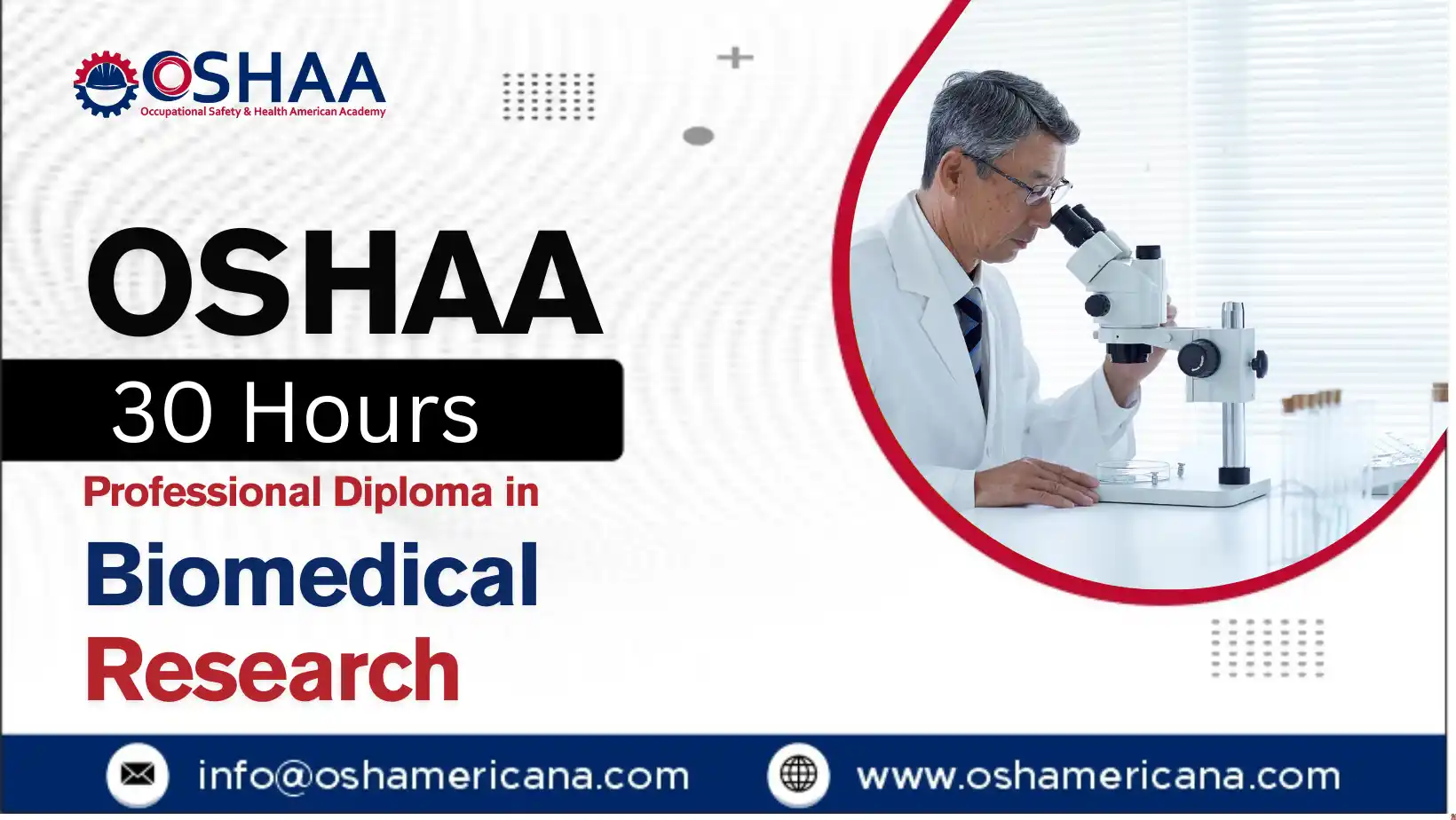
Advance Your Career with the Diploma in Biomedical Research
Biomedical research plays a critical role in advancing healthcare, understanding disease mechanisms, and developing innovative treatments. The OSHAA 30-Hours Professional Diploma in Biomedical Research offers a structured and practical introduction to this essential field, equipping participants with the fundamental knowledge and research skills needed to contribute to modern scientific discovery.
This diploma is designed for those who are passionate about health sciences and want to gain a strong foundation in research methods, ethical practice, and data interpretation. It provides participants with a comprehensive understanding of the biomedical research process from hypothesis development to publication.
The OSHAA Diploma in Biomedical Research introduces participants to core concepts in scientific investigation and laboratory research within the biomedical field. Through a blend of theoretical instruction and applied learning, participants explore the principles of experimental design, data collection, statistical analysis, and evidence-based reporting.
Spanning 30 guided hours, the course covers key topics including research methodology, literature review techniques, ethical approval processes, laboratory safety, and data interpretation. Participants will gain an understanding of the frameworks that underpin clinical trials, translational research, and biostatistics.
The OSHAA 30-Hours Professional Diploma in Biomedical Research offers a concise and focused introduction to a dynamic and impactful field. Aligned with UK academic standards, it provides participants with a valuable qualification that demonstrates their commitment to evidence-based practice and scientific integrity.
OSHAA 30-Hours Professional Diploma in Slinger
- Education: Open to learners with a basic background in science; no advanced qualifications required.
- Age: Minimum 18 years.
- Audience: Students, healthcare professionals, researchers, and NGO staff interested in biomedical studies.
- Prerequisites: Interest in medical research, laboratory practices, and scientific investigation.
Study Units
Learning Outcomes
Introduction to Biomedical Research Principles (3 Hours)
- Understand the fundamental purpose and scope of biomedical research
- Identify different types of biomedical research including basic, applied, and clinical
- Recognise the importance of scientific inquiry and evidence-based investigation
Research Design and Hypothesis Development (4 Hours)
- Formulate clear, testable research questions and hypotheses
- Distinguish between qualitative, quantitative, and mixed-methods research designs
- Select appropriate research methodologies based on study objectives
Literature Review and Source Evaluation Techniques (5 Hours)
- Conduct structured literature searches using academic databases
- Evaluate the credibility and relevance of scientific sources
- Summarise existing research to identify gaps and inform study direction
Ethics, Consent, and Regulatory Compliance in Research (6 Hours)
- Understand the principles of research ethics, including respect, beneficence, and justice
- Describe the informed consent process and its application in human research
- Comply with national and international research regulations and approval protocols
Data Collection Methods and Sampling Strategies (3 Hours)
- Identify various data collection techniques such as surveys, interviews, and experiments
- Differentiate between probability and non-probability sampling methods
- Apply appropriate sampling strategies to enhance study validity
Basic Biostatistics and Statistical Analysis (4 Hours)
- Understand key statistical concepts including mean, median, variance, and standard deviation
- Select and apply basic statistical tests for biomedical data
- Interpret statistical results in the context of research objectives
Laboratory Safety and Good Research Practices (2 Hours)
- Recognise standard laboratory safety procedures and risk management protocols
- Apply good laboratory practices including accurate documentation and sample handling
- Understand the importance of reproducibility and data integrity in research
Clinical Trials and Translational Research Concepts (3 Hours)
- Describe the phases and structure of clinical trials
- Understand the role of translational research in bridging laboratory and clinical application
- Identify challenges in moving scientific discoveries into clinical practice
The OSHAA 30-Hours Professional Diploma in Biomedical Research offers a focused and practical introduction to the principles and practices of scientific investigation within the health and life sciences. It is designed to build essential research skills and promote critical thinking among participants seeking to contribute to evidence-based advancements in healthcare, biotechnology, or academic environments.
- Enhance your ability to identify, assess, and control workplace hazards onboard vessels
- Develop the confidence to serve as a Shipboard Safety Officer or HSE specialist
- Gain a thorough understanding of international maritime regulations including SOLAS and the ISM Code
- Improve incident investigation skills to identify root causes and prevent recurrence
- Learn to implement and manage Permit to Work systems effectively
- Strengthen emergency response and crisis management capabilities
- Boost career advancement opportunities within shipping companies and maritime organizations
- Increase employability for shore-based roles such as marine superintendent or safety coordinator
- Build a strong foundation in safety management systems and audit procedures
- Demonstrate commitment to safety excellence recognized by employers industry-wide
The OSHAA 30-Hours Professional Diploma in Biomedical Research is designed for participants who wish to develop a structured and practical understanding of research in the health and life sciences. It is suitable for individuals from a range of educational and professional backgrounds who are interested in contributing to scientific knowledge, supporting research projects, or progressing to further study in biomedical fields.
This course is ideal for:
- Participants aiming to pursue careers in biomedical research, public health, or life sciences
- Individuals working in laboratories, academic institutions, or healthcare environments who seek to enhance their research competence
- Healthcare professionals looking to engage in clinical research or evidence-based practice
- Participants preparing for further study in medicine, pharmacology, biotechnology, or research methodology
- Recent graduates in biology, chemistry, health sciences, or related fields seeking foundational research training
- Individuals interested in improving their scientific writing, data analysis, and critical evaluation skills
- Those looking to support research teams in data management, ethics compliance, or laboratory work
No prior research experience is required. The course is structured to be accessible while maintaining academic relevance, making it appropriate for both new entrants and those looking to formalise or enhance their knowledge of biomedical research practices.