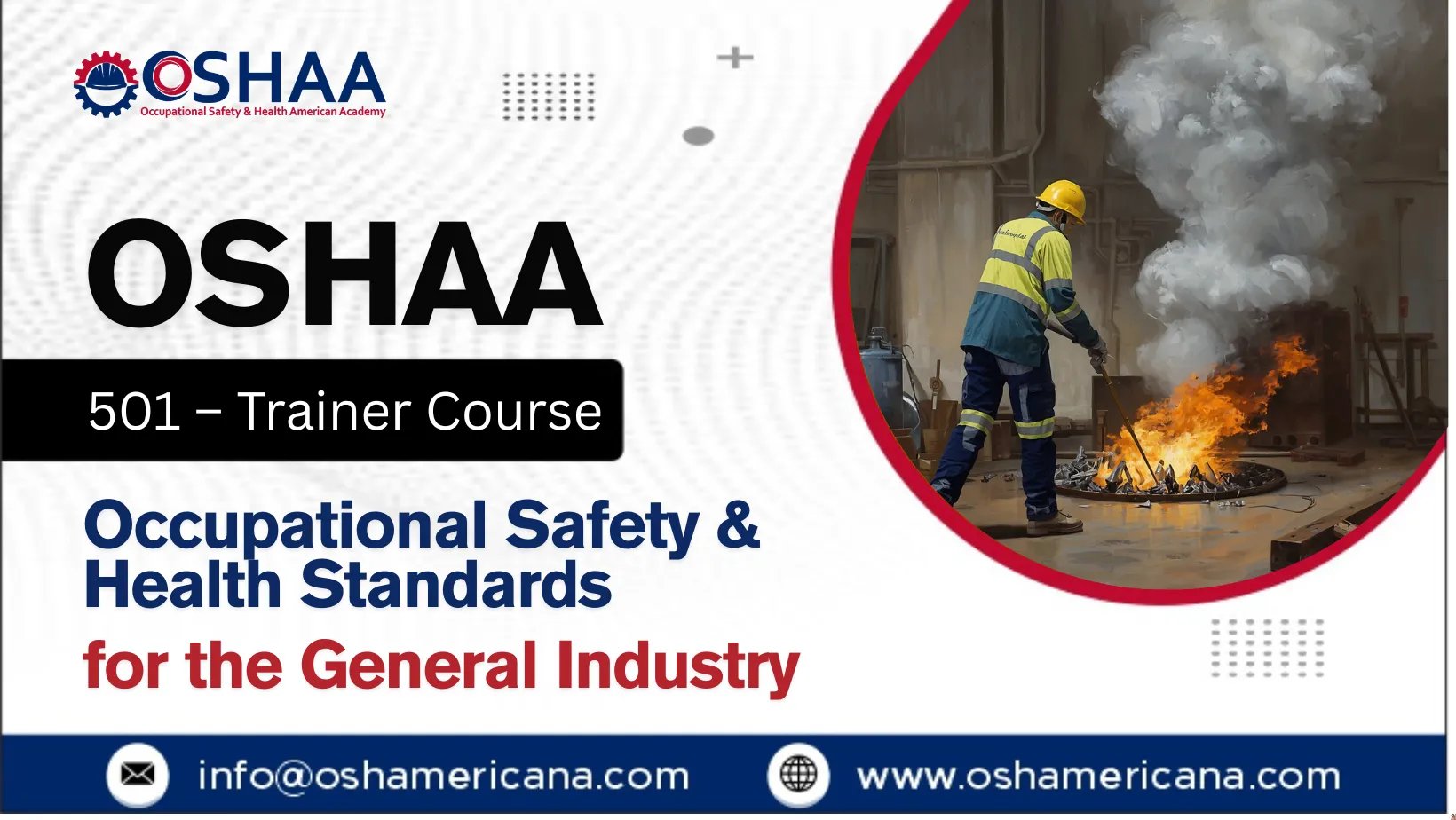
OSHA 501 Trainer Course for General Industry Safety Professionals
OSHA 501 – Trainer Course in Occupational Safety and Health Standards for General Industry is a specialised professional training programme designed for individuals who want to develop advanced knowledge of OSHA standards and workplace safety practices in general industry environments. The course focuses on helping safety professionals understand, interpret, and effectively communicate occupational safety and health requirements in the workplace.
OSHA 501 covers important areas of general industry safety, including hazard identification, electrical safety, machine guarding, personal protective equipment (PPE), hazardous materials, walking-working surfaces, emergency procedures, and workplace safety management. Learners gain a stronger understanding of how OSHA requirements can be applied to identify hazards, reduce workplace risks, and promote safer working conditions.
This course is particularly relevant for occupational safety professionals, workplace trainers, safety managers, supervisors, consultants, and other professionals involved in employee safety and OSHA compliance. It can help participants strengthen their ability to deliver effective safety training and support the development of practical workplace safety programmes.
By completing OSHA 501, learners can enhance their professional understanding of general industry OSHA standards, improve workplace safety communication, and contribute to effective occupational health and safety practices across a range of industries.
OSHA 501 – Trainer Course in Occupational Safety and Health Standards for General Industry
To enroll in the OSHA 501 – Trainer Course in Occupational Safety and Health Standards for General Industry program, candidates must meet the following requirments.
- Work Experience Requirement:
Minimum 5 years of relevant experience in general industry, safety, or a related field - Technical Knowledge Requirement:
Strong understanding of workplace hazards and OSHA general industry standards - Risk Management Knowledge:
Familiarity with hazard identification, risk assessment, and control measures - Communication Skills Requirement:
Good verbal and presentation skills for effective training delivery - Training Ability Requirement:
Ability to instruct, engage, and manage learners in a professional setting - Language Proficiency Requirement:
Basic to intermediate English proficiency (reading, writing, and speaking) - Learning Commitment Requirement:
Willingness to participate in both theoretical and practical training sessions
Study Units
Learning Outcomes
1. Introduction to Occupational Safety & Health and OSHA Framework
- Understand the principles of occupational safety and health
- Explain OSHA’s structure, purpose, and regulatory role
- Identify employer and employee responsibilities
- Interpret key OSHA policies and standards
2. OSHA General Industry Standards (29 CFR 1910) and Compliance
- Interpret OSHA 29 CFR 1910 standards
- Apply compliance requirements in workplace settings
- Identify violations and corrective actions
- Ensure adherence to regulatory obligations
3. Walking-Working Surfaces and Fall Protection
- Identify hazards related to walking-working surfaces
- Apply fall protection requirements and systems
- Implement preventive measures to reduce fall risks
- Evaluate safety practices for elevated work areas
4. Electrical Safety and Hazard Controls
- Recognize electrical hazards in the workplace
- Apply safe work practices and control measures
- Understand grounding and protective systems
- Prevent electrical accidents and injuries
5. Hazard Communication (HazCom) and Chemical Safety
- Understand Hazard Communication standards
- Interpret Safety Data Sheets (SDS) and labeling systems
- Identify chemical hazards and exposure risks
- Implement safe handling and storage practices
6. Personal Protective Equipment (PPE)
- Select appropriate PPE for various hazards
- Understand proper use, maintenance, and limitations
- Conduct PPE hazard assessments
- Promote compliance with PPE requirements
7. Machine Guarding and Industrial Equipment Safety
- Identify hazards associated with machinery
- Apply machine guarding requirements
- Ensure safe operation of industrial equipment
- Prevent injuries caused by moving parts
8. Materials Handling, Storage, and Ergonomics
- Apply safe materials handling techniques
- Identify risks related to storage practices
- Understand ergonomic principles to prevent injuries
- Reduce musculoskeletal disorders in the workplace
9. Fire Protection, Emergency Action Plans, and Exit Routes
- Identify fire hazards and prevention methods
- Develop emergency action and evacuation plans
- Ensure proper exit route design and maintenance
- Respond effectively to workplace emergencies
10. Industrial Health Hazards
- Identify health hazards such as noise and air contaminants
- Understand biological hazard risks
- Apply control measures to reduce exposure
- Promote occupational health and hygiene practices
11. Permit-Required Confined Spaces and Lockout/Tagout (LOTO)
- Identify confined space hazards and entry requirements
- Apply permit systems and safety procedures
- Understand lockout/tagout principles
- Prevent energy-related accidents and incidents
12. Safety Programs, Recordkeeping, OSHA Inspections, and Trainer Development
- Develop and implement workplace safety programs
- Maintain OSHA-required records and documentation
- Prepare for OSHA inspections and audits
- Demonstrate effective training and instructional skills
The OSHA 501 – Trainer Course in Occupational Safety and Health Standards for General Industry provides valuable professional and organizational benefits. It equips individuals with advanced safety knowledge and the skills required to become effective OSHA-authorized trainers in general industry environments.
- Authorized OSHA Trainer Status:
Qualify to deliver official OSHA 10-hour and 30-hour general industry training programs - Career Advancement Opportunities:
Access roles such as safety trainer, HSE manager, compliance officer, or consultant - Globally Recognized Certification:
Gain a respected qualification valued across multiple industries worldwide - In-Depth Safety Knowledge:
Develop strong understanding of OSHA standards, hazard identification, and risk control - Enhanced Training & Communication Skills:
Learn how to effectively deliver safety training and engage diverse audiences - Regulatory Compliance Expertise:
Help organizations meet OSHA requirements and avoid penalties - Improved Workplace Safety:
Contribute to reducing accidents, injuries, and occupational health risks - Professional Credibility:
Establish yourself as a qualified and trusted safety trainer - Higher Earning Potential:
Increase your market value with specialized trainer certification - Organizational Impact:
Support the development of a strong safety culture and continuous improvement in safety performance
This course is ideal for professionals aiming to become leaders in workplace safety and training within general industry sectors.
The OSHA 501 – Trainer Course in Occupational Safety and Health Standards for General Industry is designed for experienced professionals who want to become authorized OSHA trainers and enhance workplace safety across various industries. It is ideal for individuals responsible for safety management, compliance, and employee training.
- Safety Officers & HSE Professionals:
Individuals managing workplace health and safety in general industry settings - Supervisors & Team Leaders:
Professionals responsible for overseeing daily operations and worker safety - Engineers & Technical Staff:
Mechanical, electrical, and industrial engineers involved in operations and safety - Safety Trainers & Instructors:
Those who want to deliver OSHA-authorized training programs - Operations & Plant Managers:
Professionals ensuring safe and efficient industrial processes - Compliance Officers & Inspectors:
Individuals involved in audits, inspections, and regulatory compliance - Manufacturing & Industrial Workers:
Experienced workers seeking to advance into safety or training roles - Consultants & Safety Advisors:
Professionals providing guidance on workplace safety and OSHA compliance
This course is best suited for individuals with prior experience in general industry safety who want to build expertise and become certified OSHA trainers.