OSHAA 511 – Occupational Safety and Health Standards for General Industry
Develop practical knowledge of workplace hazards, safety controls, and relevant U.S. Occupational Safety and Health Administration (OSHA) General Industry Standards. This OSHAA course introduces learners to key requirements in 29 CFR Part 1910 and their application across manufacturing, warehousing, facilities, and other general industry workplaces.
Delivered through OSHAA Approved Training Partners (ATPs), the course supports learners who want to strengthen their understanding of occupational safety and health requirements and apply safer work practices in their professional roles.
Who Should Take This Course?
This course is suitable for people who work in, support, supervise, or are preparing for safety-related responsibilities in general industry environments.
Entry Requirements
- Age
- Applicants should be at least 18 years old.
- Education
- A high school diploma or equivalent is recommended.
- Language
- English proficiency sufficient to understand course materials and assessment questions.
- Experience
- General industry or workplace safety experience is helpful but not mandatory.
- Preparation
- Prior safety training may be beneficial. Confirm any additional enrollment conditions with the ATP.
Course Units
The OSHAA 511 course is organised into 12 units covering general industry workplace safety, hazard awareness, protective measures, and safety programme practices.
| # | Course Unit | Course Coverage |
|---|---|---|
| 1 | Introduction to OSHA and General Industry Safety Regulations | |
| 2 | OSHA General Industry Standards (29 CFR 1910) Overview | |
| 3 | Walking-Working Surfaces and Fall Protection | |
| 4 | Electrical Safety and Hazard Controls | |
| 5 | Hazard Communication (HazCom) and Chemical Safety | |
| 6 | Personal Protective Equipment (PPE) | |
| 7 | Machine Guarding and Industrial Equipment Safety | |
| 8 | Materials Handling, Storage, and Ergonomics | |
| 9 | Fire Protection, Emergency Action Plans, and Exit Routes | |
| 10 | Industrial Health Hazards: Noise, Air Contaminants, and Biological Hazards | |
| 11 | Permit-Required Confined Spaces and Lockout/Tagout (LOTO) | |
| 12 | Safety Programs, Recordkeeping, OSHA Inspections, and Compliance Practices |
What You Will Learn
By the end of the course, learners should be able to demonstrate the following knowledge and skills:
1Introduction to OSHA and General Industry Safety Regulations
- Describe the purpose and general role of the Occupational Safety and Health Administration.
- Explain the broad responsibilities of employers and employees under applicable occupational safety and health requirements.
- Recognize the distinction between federal OSHA standards and other workplace safety guidance.
- Identify how regulatory requirements relate to workplace hazard prevention.
2OSHA General Industry Standards (29 CFR 1910) Overview
- Explain the structure and general scope of 29 CFR Part 1910.
- Locate relevant General Industry Standards using section and subpart references.
- Recognize that standard applicability depends on work activities, hazards, and workplace circumstances.
- Use regulatory references to support informed workplace safety discussions.
3Walking-Working Surfaces and Fall Protection
- Identify common hazards involving floors, aisles, ladders, stairways, and elevated surfaces.
- Explain the purpose of housekeeping and safe access and egress arrangements.
- Recognize circumstances in which fall protection requirements may apply.
- Describe preventive measures for reducing slips, trips, and falls.
4Electrical Safety and Hazard Controls
- Identify common electrical hazards in general industry workplaces.
- Describe safe practices relating to electrical equipment and installations.
- Recognize the importance of inspection, maintenance, and qualified personnel where required.
- Explain basic controls for reducing electrical shock, burn, and fire risks.
5Hazard Communication (HazCom) and Chemical Safety
- Explain the purpose of the Hazard Communication Standard.
- Identify the role of chemical labels and Safety Data Sheets (SDS).
- Describe how employees receive information and training about hazardous chemicals.
- Recognize safe storage, handling, and exposure-prevention practices.
6Personal Protective Equipment (PPE)
- Explain why workplace hazards should be assessed before selecting PPE.
- Identify common types of eye, face, head, hand, foot, and respiratory protection.
- Describe appropriate use, inspection, care, and limitations of PPE.
- Recognize that respiratory protection requirements may include a written program and other measures when applicable.
7Machine Guarding and Industrial Equipment Safety
- Identify common points-of-operation, rotating-part, and other machinery hazards.
- Explain the purpose of machine guards and protective devices.
- Recognize the importance of using equipment as intended and following safe operating procedures.
- Describe how guarding and maintenance practices can reduce exposure to machine hazards.
8Materials Handling, Storage, and Ergonomics
- Identify hazards associated with lifting, carrying, pushing, pulling, and storing materials.
- Describe safe storage and material-handling practices.
- Recognize ergonomic risk factors in tasks and workstation design.
- Suggest practical ways to reduce strain and improve handling safety.
9Fire Protection, Emergency Action Plans, and Exit Routes
- Identify common workplace fire hazards and basic prevention measures.
- Explain the purpose of emergency action plans and fire prevention plans where required.
- Recognize requirements and good practices relating to exit routes and evacuation arrangements.
- Describe the importance of alarms, communication, drills, and assigned emergency responsibilities.
10Industrial Health Hazards
- Recognize common physical, chemical, and biological occupational health hazards.
- Explain basic approaches to recognizing, evaluating, and controlling workplace exposures.
- Describe the importance of noise exposure controls and applicable health standards.
- Identify when additional technical assessment or occupational health expertise may be needed.
11Permit-Required Confined Spaces and Lockout/Tagout
- Identify characteristics and hazards of permit-required confined spaces.
- Explain the purpose of entry permits, atmospheric testing, attendants, and rescue arrangements.
- Describe the purpose of hazardous-energy control and lockout/tagout procedures.
- Distinguish the general roles of authorized and affected employees.
12Safety Programs, Recordkeeping, OSHA Inspections, and Compliance Practices
- Explain how workplace safety programs can support hazard prevention and continual improvement.
- Recognize which employers and incidents may be subject to OSHA injury and illness recordkeeping requirements.
- Identify the general purpose of OSHA Forms 300, 300A, and 301 where applicable.
- Describe how inspections, accurate records, corrective actions, and employee involvement can support workplace safety.
Assessment and Certification
How You Are Assessed
- The assessment is conducted through quiz-based assessments administered by an OSHAA Approved Training Partner (ATP).
- The examination consists of 100 multiple-choice questions (MCQs) designed to measure understanding of course content and application of safety concepts in real workplace situations.
- A minimum score of 70% is required to successfully pass.
Your Certificate
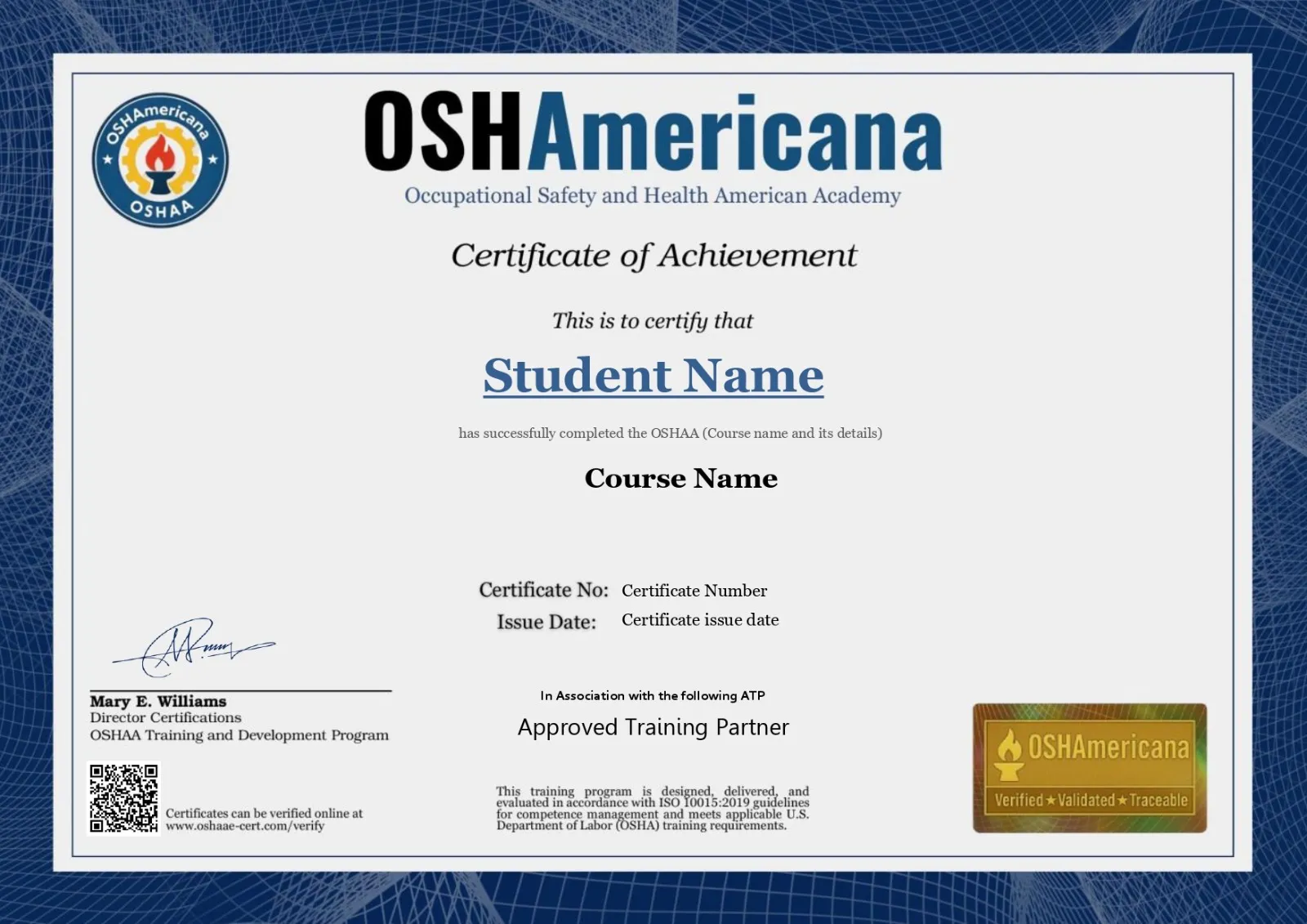
After completing the course requirements and achieving the required pass mark, successful learners receive an OSHAA 511 course certificate issued by the Occupational Safety and Health American Academy (OSHAA). Certificate details can be checked through the OSHAA verification service.
Benefits of the OSHAA 511 Course
Understand General Industry Safety
Build knowledge of workplace safety principles and practices across general industry environments.
Strengthen Hazard Recognition
Develop knowledge of common physical, chemical, electrical, and occupational health hazards.
Explore Practical Risk Controls
Understand the role of guarding, PPE, energy control, safe handling, and other preventive measures.
Improve Safety Communication
Build awareness of safety information, employee training, documentation, and emergency arrangements.
Support Workplace Safety Activities
Apply course knowledge when contributing to inspections, hazard reporting, and safety improvement activities.
Build Professional Knowledge
Add structured general industry safety learning to your professional development.
Career Opportunities and Relevant U.S. Job Roles
The knowledge covered in this course may be relevant to entry-level and developing responsibilities in workplace safety, operations, and compliance. Actual job eligibility depends on the employer, experience, education, industry requirements, and any additional credentials or licenses required for the position.
Occupational Safety Assistant
Supports safety documentation, hazard reporting, inspections, and routine safety activities.
Safety Coordinator
Helps coordinate safety communication, training records, inspections, and corrective-action follow-up.
Environmental, Health and Safety (EHS) Technician
Assists with workplace monitoring, safety records, hazard identification, and EHS procedures.
Manufacturing Safety Representative
Supports safe production practices, equipment safety awareness, and hazard reporting.
Warehouse Safety Coordinator
Contributes to safe material handling, storage, housekeeping, and powered-equipment safety awareness.
Facilities Safety Assistant
Supports facility inspections, maintenance safety coordination, and emergency preparedness activities.
Operations or Production Supervisor
Applies safety knowledge while coordinating work activities and communicating workplace expectations.
Safety Training Support
Assists with arranging safety briefings, maintaining training records, and communicating safety information.
Frequently Asked Questions About OSHAA 511
What is the OSHAA 511 course?
OSHAA 511 – Occupational Safety and Health Standards for General Industry is an OSHAA course that develops knowledge of general industry workplace safety principles and practices. It is delivered through OSHAA Approved Training Partners.
Who should take this general industry safety course?
The course may be useful for safety officers, EHS personnel, manufacturing and warehouse supervisors, maintenance and facilities staff, engineers, operations personnel, and people developing workplace safety responsibilities.
What are the entry requirements?
Applicants should be at least 18 years old. A high school diploma or equivalent and English proficiency are recommended. Previous general industry or safety experience can be helpful but is not mandatory based on the published course information. Confirm any additional enrollment conditions with the ATP.
How is the OSHAA 511 course assessed?
The assessment is a quiz-based examination conducted through an OSHAA Approved Training Partner. It consists of 100 multiple-choice questions (MCQs). Learners must achieve at least 70% to pass.
Who issues the OSHAA 511 certificate?
Successful learners receive an OSHAA 511 course certificate issued by the Occupational Safety and Health American Academy (OSHAA), subject to completion of the course requirements and the required assessment result.
Is the OSHAA 511 course available online?
Study formats depend on the Approved Training Partner. Some partners may offer online, classroom, or blended arrangements. Contact the ATP to confirm the options currently available.
Can learners outside the United States take this course?
Availability depends on the OSHAA Approved Training Partner. The course focuses on U.S. OSHA General Industry Standards. Learners outside the United States should also follow the occupational safety and health laws that apply in their own country.
How can an employer verify an OSHAA certificate?
Employers can use the OSHAA certificate verification service and follow the instructions provided there to check certificate details.
How do I find an OSHAA Approved Training Partner?
Visit the OSHAA Approved Training Partner directory or contact support@oshamericana.com for assistance with available training options.
How to Study the OSHAA 511 Course
OSHAA is the awarding organization. Learners enroll and study through an OSHAA Approved Training Partner, which provides course delivery and learner support. Available study formats, schedules, and fees are confirmed by the selected partner.
- 1
Find a Training Partner
Choose an OSHAA Approved Training Partner or contact OSHAA for assistance.
- 2
Enroll With the Partner
Confirm enrollment requirements, course fees, available study format, and schedule.
- 3
Complete the Course
Study the course units and develop knowledge of relevant general industry safety requirements.
- 4
Complete the Assessment
Attempt the 100-question MCQ assessment and achieve at least 70% to pass.
- 5
Receive Your OSHAA Certificate
Successful learners receive an OSHAA 511 course certificate that can be verified online.