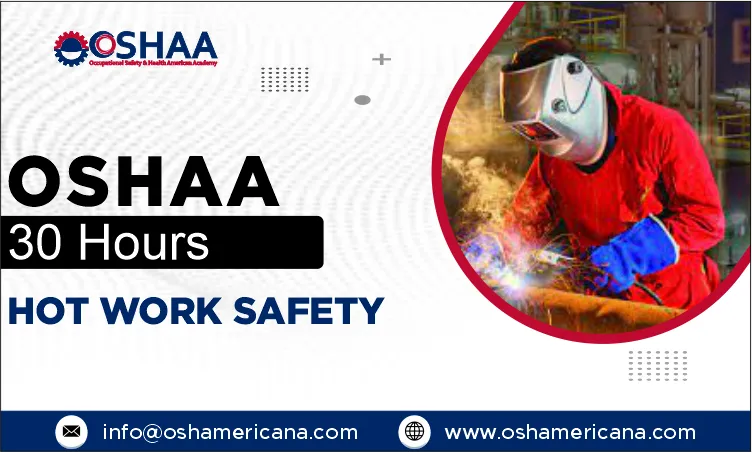
Master Hot Work Safety with Professional Diploma
The OSHAA 30-Hours Professional Diploma in Hot Work Safety is a specialized training program designed to address one of the most critical safety concerns across industries where hot work is performed. Hot work activities such as welding, cutting, brazing, and grinding are essential to industrial operations, yet they are also among the most hazardous tasks when not managed with strict safety protocols. This professional diploma provides learners with the advanced knowledge and practical skills required to carry out hot work operations safely, ensuring compliance with OSHA standards while protecting both workers and workplaces from preventable risks.
The OSHAA 30-Hours Professional Diploma in Hot Work Safety emphasizes the importance of hazard recognition, fire prevention strategies, and emergency preparedness in environments where hot work is conducted. Participants gain an in-depth understanding of how heat, sparks, and flammable materials can interact to create dangerous situations, and they are trained in best practices to mitigate these risks. Through detailed study and practical application, learners build the confidence to implement strict safety measures, conduct risk assessments, and enforce proper work permits, ensuring that hot work operations are completed without compromising worker safety or organizational compliance.
This diploma is not only relevant to workers who perform hot work but also to supervisors, managers, and safety officers responsible for overseeing industrial operations. The OSHAA 30-Hours Professional Diploma in Hot Work Safety equips participants with the ability to identify potential hazards before they escalate, implement regulatory-approved control measures, and ensure that workplaces adhere to international safety standards. By integrating OSHA compliance into daily operations, organizations reduce the risk of fires, explosions, and serious injuries, while reinforcing a culture of accountability and continuous improvement.
OSHAA 30-Hours Professional Diploma in Hot Work Safety
To enroll in this course, learners should meet the following basic requirements to ensure safe understanding and effective application of hot work safety procedures:
- Age Requirement: Applicants should be at least 18 years of age or older at the time of enrollment, as hot work activities involve high-risk environments and require responsible handling of safety procedures.
- Educational Background: A basic secondary education (high school level or equivalent) is recommended. Prior knowledge in occupational health and safety, construction, welding, engineering, manufacturing, or related safety certifications will be beneficial but is not mandatory.
- Language Proficiency: Learners should have a basic understanding of English to read safety instructions, warning signs, training materials, and emergency procedures effectively.
- Work Experience: No formal experience is required; however, experience in welding, fabrication, construction, maintenance, or industrial work environments can be helpful for practical understanding of hot work operations.
- Physical Fitness: Learners should be physically capable of working in industrial or high-heat environments and following strict safety procedures.
This course is suitable for both beginners and professionals who want to strengthen their knowledge of hot work safety and comply with OSHA-aligned workplace safety standards.
Study Units
Learning Outcomes
Introduction to Hot Work (2 Hours)
- Understand the definition, scope, and purpose of hot work activities
- Identify different types of hot work operations such as welding, cutting, and grinding
- Recognise the risks and hazards associated with hot work tasks
- Gain awareness of the importance of hot work safety in preventing accidents
- Become familiar with relevant legal and regulatory frameworks (OSHA, NFPA, etc.)
Identifying and Assessing Hot Work Hazards (3 Hours)
- Recognise the various hazards associated with hot work operations
- Learn to conduct risk assessments specific to hot work environments
- Identify common environmental hazards, including flammable materials and toxic fumes
- Apply hazard identification techniques and checklists to maintain safety
- Understand the importance of pre-job safety assessments to mitigate risk
Fire Prevention and Protection Measures (4 Hours)
- Learn effective fire prevention techniques tailored for hot work activities
- Understand the role of fire-resistant materials and barriers in reducing fire risk
- Recognise and implement proper fire watch procedures during hot work
- Know how to use fire protection equipment, including extinguishers, blankets, and suppression systems
- Implement post-work safety measures to ensure continued fire protection
Personal Protective Equipment (PPE) for Hot Work (3 Hours)
- Identify the types of PPE required for hot work operations
- Understand the importance of PPE in preventing injuries and ensuring worker safety
- Learn proper usage, maintenance, and care for hot work PPE
- Understand task-specific PPE requirements for welding, cutting, and grinding
- Assess PPE fit and compliance for workers in hot work environments
Hot Work Permits and Procedures (5 Hours)
- Gain knowledge of the hot work permit system and its purpose
- Learn correct procedures for obtaining and issuing hot work permits
- Understand the key elements that must be included in a permit
- Implement the permit system effectively before, during, and after hot work operations
- Recognise roles and responsibilities of workers, supervisors, and safety officers in permit compliance
Handling Emergency Situations and First Aid (4 Hours)
- Understand how to recognise and respond to hot work-related emergencies
- Learn basic first aid techniques for burns, injuries, and smoke inhalation
- Know the steps to take during fires, explosions, or other emergencies
- Familiarise with workplace evacuation procedures and emergency response protocols
- Understand the importance of quick decision-making and communication during incidents
Fire Watch and Post-Work Safety (5 Hours)
- Understand the role and responsibilities of a fire watch during and after hot work
- Learn how to monitor for potential fires and hazards after work completion
- Know the duration of fire watch and actions to take if a fire is detected
- Understand procedures for safe disposal of waste and hazardous materials
- Implement post-work safety checks to ensure the area is cleared of risks
Regulatory Standards and Compliance (4 Hours)
- Become familiar with OSHA hot work regulations, including OSHA 1910.252
- Understand industry-specific standards such as NFPA 51B and ANSI Z49.1
- Learn the importance of safety audits and risk management in hot work operations
- Recognise consequences of non-compliance with hot work safety standards
- Understand proper documentation and record-keeping to maintain compliance
This course is designed to provide advanced knowledge and practical skills in hot work safety, ensuring safe execution of welding, cutting, grinding, and other high-risk operations in line with Occupational Safety and Health Administration (OSHA) principles.
- Hot Work Safety Knowledge: Gain a clear understanding of hot work hazards including fire, explosions, and burns.
- Risk Assessment Skills: Learn how to identify and evaluate risks before starting hot work operations.
- Fire Prevention Techniques: Develop skills to implement fire safety measures and control ignition sources.
- Safe Work Procedures: Understand correct procedures for welding, cutting, grinding, and related tasks.
- Permit-to-Work Awareness: Learn about hot work permits and workplace authorization systems.
- Emergency Response Skills: Improve ability to respond quickly and effectively to fire or accident situations.
- Equipment Safety: Gain knowledge of safe use, inspection, and maintenance of hot work equipment.
- Workplace Compliance: Strengthen understanding of OSHA-based safety regulations and standards.
- Injury Prevention: Reduce risks of burns, fire injuries, and workplace accidents.
- Career Advancement: Improve employability in construction, manufacturing, welding, and industrial safety roles.
This course is designed for individuals who want to develop strong knowledge and practical skills in hot work safety, ensuring safe execution of welding, cutting, grinding, and other high-risk industrial operations in line with Occupational Safety and Health Administration (OSHA) principles.
- Welders & Fabricators: Professionals involved in welding, cutting, brazing, and metal fabrication activities.
- Construction Workers: Site workers and supervisors exposed to hot work operations and fire-related hazards.
- Industrial & Manufacturing Staff: Employees working in factories, production units, and heavy engineering environments.
- Maintenance Technicians: Workers responsible for repair, installation, and equipment maintenance involving hot work tasks.
- Safety Officers & Supervisors: Professionals responsible for enforcing workplace safety rules and monitoring hot work activities.
- Oil & Gas Workers: Individuals working in high-risk environments with fire and explosion hazards.
- Electrical & Mechanical Engineers: Professionals involved in industrial systems where hot work may be required.
- Fire Safety Teams: Personnel responsible for fire prevention, control, and emergency response in industrial sites.
- Students & Trainees: Learners studying occupational safety, engineering, or technical trades.
- Aspiring Industrial Workers: Individuals planning to enter welding, construction, or manufacturing industries.