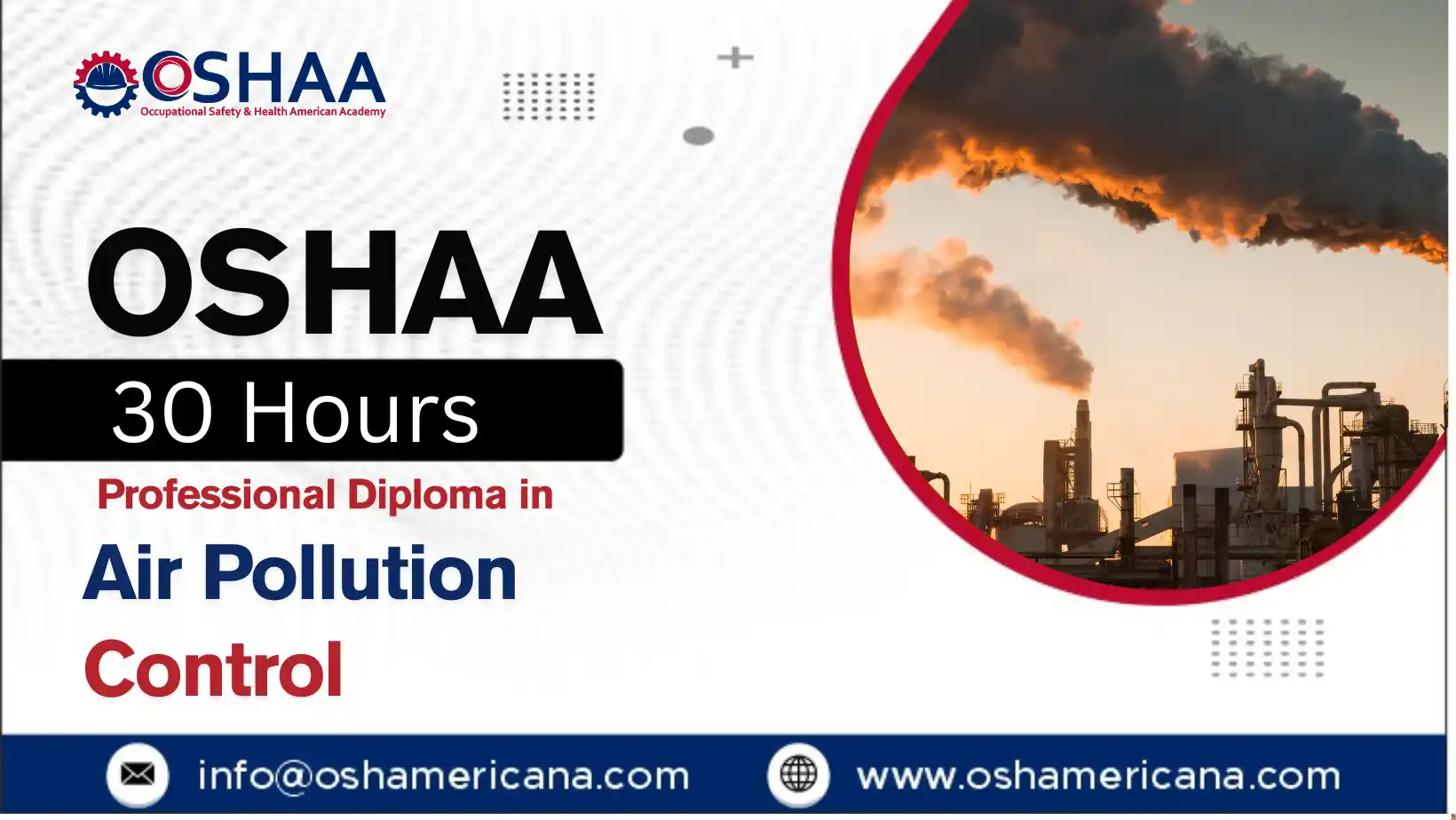
Professional Diploma in Air Pollution Control – Master Environmental Protection & Safety Skills
Air pollution remains one of the most pressing environmental and public health challenges of the 21st century. Industrial growth, transportation, and urbanisation continue to contribute to deteriorating air quality, impacting human health, ecosystems, and climate stability. The OSHAA 30-Hours Professional Diploma in Air Pollution Control offers an essential qualification for professionals seeking to play a key role in managing and mitigating air pollution across various sectors.
The OSHAA 30-Hours Diploma is a structured training programme that delivers critical insights into the sources, effects, and control technologies related to air pollution. Participants will explore the principles of atmospheric science, pollution dispersion modelling, emissions management, and regulatory compliance.
Upon successful completion, participants may choose to progress to advanced certifications such as the OSHAA 60-Hours Advanced Diploma in Environmental Management or pursue specialisation in areas like industrial emissions control, carbon footprint analysis, or sustainable urban planning.
The OSHAA 30-Hours Professional Diploma in Air Pollution Control equips participants with the tools to address one of the most significant environmental challenges of our time. As air quality becomes increasingly central to health and sustainability policies worldwide, professionals with expertise in pollution control will remain in high demand.
OSHAA 30-Hours Professional Diploma in Air Pollution Control
- • Age Requirement: Learners should be 16 years or above.
- • Educational Requirement: Minimum Matric or equivalent qualification (background in science, environmental studies, chemistry, or geography is helpful).
- • Language Requirement: Basic understanding of English is required for study materials and assessments.
- • Experience: No prior experience is required, but exposure to environmental or industrial work is an advantage.
Study Units
Learning Outcomes
Introduction to Air Pollution and Environmental Impact (3 hours)
- Understand the definition and scope of air pollution in modern contexts
- Identify the main environmental consequences of air pollution
- Recognise the relationship between air quality and climate change
- Explain the importance of air pollution control in sustainable development
Classification and Sources of Air Pollutants (5 hours)
- Classify major types of air pollutants (primary and secondary)
- Identify common natural and anthropogenic sources of air pollutants
- Distinguish between stationary, mobile, and indoor pollution sources
- Evaluate sector-specific contributions to air pollution (e.g. transport, industry)
Atmospheric Chemistry and Pollution Dispersion (3 hours)
- Understand basic principles of atmospheric chemistry related to pollution
- Explain the formation of secondary pollutants like ozone and particulate matter
- Describe the mechanisms of pollutant dispersion and deposition
- Interpret factors affecting pollutant behaviour in the atmosphere
Air Quality Monitoring and Sampling Techniques (4 hours)
- Identify key air quality indicators and pollutant measurement parameters
- Use appropriate equipment and methods for air sampling and data collection
- Interpret air quality monitoring results against regulatory standards
- Apply monitoring techniques in both outdoor and indoor settings
Indoor Air Quality Management and Assessment (5 hours)
- Define factors influencing indoor air quality in commercial and industrial settings
- Identify common indoor pollutants and their health impacts
- Assess ventilation systems and other environmental controls
- Implement strategies to improve and maintain indoor air quality
Emission Control Technologies and Systems (5 hours)
- Understand the operation of key emission control devices (e.g. scrubbers, filters)
- Evaluate the effectiveness of different technologies for various pollutants
- Design basic control strategies for industrial and mobile emission sources
- Integrate control systems into existing operational frameworks
Legal Frameworks and Regulatory Compliance (3 hours)
- Interpret national and international air quality legislation
- Understand the roles of environmental regulatory bodies and standards
- Identify legal responsibilities of businesses and environmental professionals
- Ensure compliance with reporting, permitting, and emission control requirements
Health and Ecological Effects of Air Pollution (2 hours)
- Recognise short- and long-term health effects of air pollutants on humans
- Understand the impact of air pollution on ecosystems, wildlife, and agriculture
- Link pollutant types to specific health and environmental outcomes
- Advocate for pollution prevention as part of public and environmental health strategies
- • Gain in-depth knowledge of air pollution sources, causes, and environmental impacts
- • Understand air quality management principles and pollution control strategies
- • Learn monitoring techniques used to measure and assess air pollution levels
- • Develop practical skills to implement pollution reduction and control measures
- • Improve awareness of environmental laws and compliance standards related to air quality
- • Strengthen problem-solving abilities for environmental and industrial pollution issues
- • Enhance career opportunities in environmental science, health, and safety sectors
- • Build competence in sustainable practices to support environmental protection initiatives
- • Understand the impact of pollution on human health and ecosystems
- • Create a strong foundation for advanced studies in environmental management and sustainability
This course is ideal for individuals working in or preparing for roles that involve environmental protection, air quality management, and regulatory compliance. It is particularly suited for:
- Environmental health and safety officers
- Industrial and manufacturing site managers
- Environmental compliance and regulatory professionals
- Sustainability and environmental consultants
- Air quality monitoring technicians and analysts
- Urban planners and environmental engineers
- Public health professionals focused on environmental hazards
- Government and local authority staff involved in environmental oversight
- Graduates in environmental science, engineering, or related fields
- Professionals seeking to upskill in pollution control and environmental risk management
No prior qualification is required, making the course accessible to both early-career professionals and experienced personnel looking to enhance their environmental expertise.