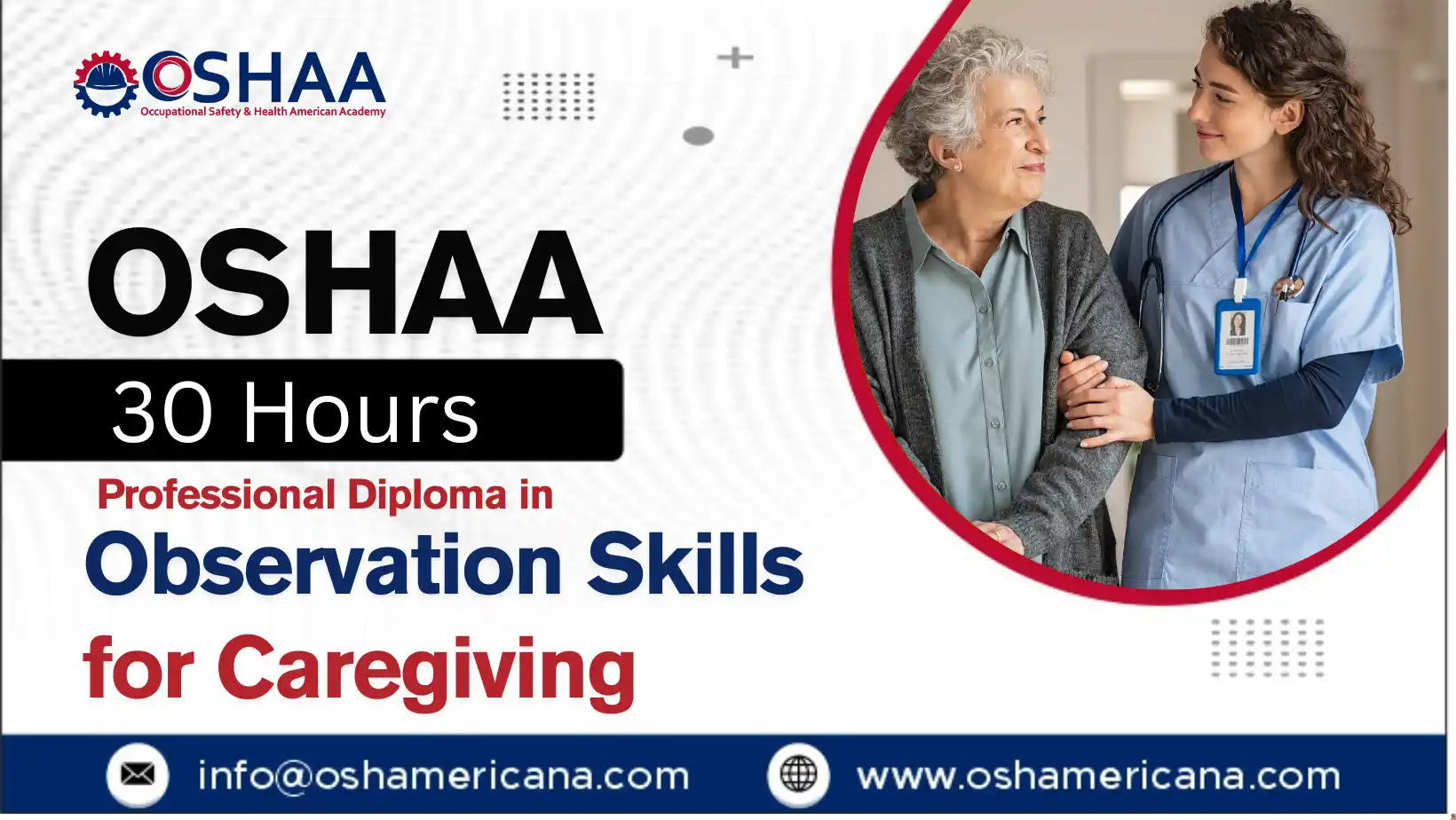
Professional Diploma in Caregiving Observation Skills – Master Patient Monitoring Techniques
In the ever-evolving landscape of health and social care, the ability to observe and assess changes in a patient’s condition is essential. The OSHAA 30-Hours Professional Diploma in Observation Skills for Caregiving is specifically designed to equip participants with the practical skills and theoretical knowledge necessary to enhance the quality of care delivered across a range of settings.
This comprehensive diploma programme focuses on developing acute observational skills, enabling participants to identify early signs of physical, emotional, and behavioural changes in individuals under their care. Whether working in residential care, domiciliary care, or within a hospital environment, precise and timely observation is a cornerstone of effective caregiving.
Throughout the course, participants engage with evidence-based learning modules that cover essential topics such as monitoring vital signs, recognising signs of distress, documenting behavioural patterns, and understanding non-verbal cues. Emphasis is placed on both the practical application of skills and the ethical considerations involved in observing and recording patient information.
The OSHAA 30-Hours Professional Diploma in Observation Skills for Caregiving is a valuable investment in professional development, enhancing participants’ ability to deliver safe, person-centred, and responsive care. As demand for high-quality caregiving continues to grow, this diploma positions participants at the forefront of care excellence.
OSHAA 30-Hours Professional Diploma in Observation Skills for Caregiving
- • Age Requirement: Learners should be 16 years or above.
- • Educational Requirement: Minimum Matric or equivalent qualification (background in healthcare, nursing, or social care is helpful).
- • Language Requirement: Basic understanding of English is required for study and assessments.
- • Experience: No prior caregiving experience is required, but exposure to healthcare or support work is an advantage.
Study Units
Learning Outcomes
Introduction to Observation in Caregiving (3 hours)
- Participants will understand the fundamental role of observation in effective caregiving.
- Participants will identify the key purposes and benefits of observational skills in various care settings.
- Participants will develop an awareness of the responsibilities associated with accurate observation in line with care standards.
Monitoring and Recording Vital Signs (4 hours)
- Participants will learn to accurately measure and interpret temperature, pulse, respiration, and blood pressure.
- Participants will understand the significance of deviations from normal ranges in vital signs.
- Participants will be able to document vital signs effectively, following professional and organisational protocols.
Recognising Physical and Emotional Changes (5 hours)
- Participants will identify early signs of physical deterioration and emotional distress in individuals.
- Participants will develop skills to distinguish between normal age-related changes and signs of concern.
- Participants will enhance their ability to act appropriately upon recognising changes in a care recipient’s condition.
Understanding Non-Verbal Communication (3 hours)
- Participants will explore the importance of body language, facial expressions, and gestures in caregiving.
- Participants will interpret non-verbal cues to better understand individuals who may have limited verbal communication.
- Participants will use non-verbal communication to build trust and rapport in care relationships.
Behavioural Observation and Mental Health Indicators (4 hours)
- Participants will understand common behavioural patterns associated with mental health conditions.
- Participants will learn techniques for observing and documenting behavioural changes.
- Participants will recognise the importance of timely intervention and appropriate referrals.
Documentation and Reporting Techniques (3 hours)
- Participants will develop competence in accurate and objective record-keeping.
- Participants will understand the legal and ethical importance of proper documentation.
- Participants will be able to report observational findings clearly to support effective care planning.
Safeguarding and Ethical Observation Practices (3 hours)
- Participants will gain knowledge of safeguarding principles in relation to observation.
- Participants will understand the boundaries of ethical observation and privacy considerations.
- Participants will learn how to report safeguarding concerns responsibly and sensitively.
Effective Communication with Multidisciplinary Teams (5 hours)
- Participants will understand the role of observation in supporting coordinated care.
- Participants will develop skills to communicate observations effectively with nurses, doctors, and allied health professionals.
- Participants will learn to participate in team discussions and contribute to care planning using observed evidence.
- • Develop strong observation skills to accurately monitor patient health, behavior, and condition changes
- • Improve caregiving quality by identifying early signs of patient needs and potential risks
- • Enhance communication skills for reporting observations clearly to healthcare professionals
- • Gain confidence in patient care through better understanding of physical and emotional indicators
- • Strengthen attention to detail essential for safe and effective caregiving practices
- • Learn systematic assessment techniques for monitoring patient progress and well-being
- • Increase employability in hospitals, care homes, clinics, and community healthcare settings
- • Support patient safety by detecting changes in condition at an early stage
- • Build professional caregiving competence for both entry-level and experienced caregivers
- • Create a strong foundation for advanced studies in healthcare, nursing, and clinical support roles
The OSHAA 30-Hours Professional Diploma in Observation Skills for Caregiving is ideal for individuals working or aspiring to work in the health and social care sector. It is particularly suited to:
- Aspiring caregivers seeking to build foundational skills in professional observation and care delivery
- Current care workers, support workers, and healthcare assistants wishing to enhance their observational competencies
- Residential and domiciliary care staff responsible for monitoring the wellbeing of vulnerable individuals
- Staff working in hospitals, nursing homes, or community care environments who are involved in daily patient interaction
- Professionals looking to meet compliance standards and improve their ability to document and report care observations
- Individuals preparing for supervisory roles who need a stronger understanding of observation within team-based care
- Anyone interested in pursuing a recognised qualification that supports career progression in the caregiving and health support fields
This course is suitable for both new entrants and experienced practitioners who wish to formalise their skills and stay aligned with best practices in person-centred care.