OSHA 501 – Trainer Course in Occupational Safety and Health Standards for General Industry
The OSHAA OSHA 501 – Trainer Course in Occupational Safety and Health Standards for General Industry develops advanced knowledge of workplace safety topics and effective safety instruction. The 12-unit curriculum covers general industry safety principles, walking-working surfaces, electrical hazards, Hazard Communication, personal protective equipment, machine guarding, materials handling, fire protection, industrial health hazards, confined spaces and lockout/tagout.
Designed for experienced safety professionals, supervisors, engineers and workplace training personnel, the course supports the development of subject knowledge, safety communication and instructional skills for general industry settings.
Who Should Take This Course?
This OSHAA course is intended for experienced professionals who work with workplace safety, industrial operations, employee development or safety communication in general industry settings.
Entry Requirements
- Work Experience
- The published course information recommends at least five years of relevant experience in general industry, occupational safety or a related field.
- Technical Knowledge
- Applicants should have a working understanding of workplace hazards and general industry safety topics.
- Risk Management
- Familiarity with hazard identification, risk assessment and control measures is recommended.
- Communication
- Verbal communication and presentation skills are beneficial for participating in instructional activities.
- Language
- English proficiency sufficient to understand course materials, participate in learning activities and complete the assessment.
- Additional Conditions
- Confirm any further enrollment requirements, evidence of experience and course arrangements with the selected OSHAA Approved Training Partner.
OSHA 501 Course Units
The 12 units combine general industry safety subject knowledge with workplace communication and trainer-development themes. Each unit contributes to the overall course learning programme.
| # | Course Unit | Coverage |
|---|---|---|
| 1 | Introduction to Occupational Safety and Health and OSHA Framework | |
| 2 | OSHA General Industry Standards (29 CFR 1910) and Workplace Applications | |
| 3 | Walking-Working Surfaces and Fall Protection | |
| 4 | Electrical Safety and Hazard Controls | |
| 5 | Hazard Communication (HazCom) and Chemical Safety | |
| 6 | Personal Protective Equipment (PPE) | |
| 7 | Machine Guarding and Industrial Equipment Safety | |
| 8 | Materials Handling, Storage, and Ergonomics | |
| 9 | Fire Protection, Emergency Action Plans, and Exit Routes | |
| 10 | Industrial Health Hazards: Noise, Air Contaminants, and Biological Hazards | |
| 11 | Permit-Required Confined Spaces and Lockout/Tagout (LOTO) | |
| 12 | Safety Programs, Recordkeeping, Workplace Inspections, and Trainer Development |
Learning Outcomes
On completion of the learning activities, learners should be able to explain relevant general industry safety concepts and communicate key information in a structured learning environment.
1Introduction to Occupational Safety and Health and OSHA Framework
- Describe core occupational safety and health concepts and the purpose of workplace safety programmes.
- Explain the general role of OSHA in U.S. workplace safety.
- Identify employer, employee and safety professional responsibilities.
- Communicate foundational safety concepts to workplace learners.
2OSHA General Industry Standards (29 CFR 1910) and Workplace Applications
- Navigate the subject areas of 29 CFR Part 1910 relevant to general industry.
- Recognise how standards relate to common industrial activities.
- Explain selected safety requirements using clear workplace examples.
- Organise standard-related information for learning and discussion.
3Walking-Working Surfaces and Fall Protection
- Identify hazards associated with floors, aisles, stairs, ladders and elevated work areas.
- Explain measures used to prevent slips, trips and falls.
- Describe the purpose of walking-working surface inspections.
- Present key prevention messages to workplace learners.
4Electrical Safety and Hazard Controls
- Recognise electrical hazards in general industry workplaces.
- Explain safe work practices and the purpose of protective measures.
- Identify common electrical risk scenarios.
- Communicate electrical safety topics in a structured learning session.
5Hazard Communication (HazCom) and Chemical Safety
- Explain the purpose of a workplace Hazard Communication programme.
- Interpret key information on labels and Safety Data Sheets (SDS).
- Identify chemical exposure and handling concerns.
- Present basic chemical hazard awareness information.
6Personal Protective Equipment (PPE)
- Identify workplace tasks that may require personal protective equipment.
- Explain selection, fit, use, care and limitations of PPE.
- Recognise the importance of hazard assessment when selecting PPE.
- Communicate PPE expectations and safe-use information.
7Machine Guarding and Industrial Equipment Safety
- Identify common hazards associated with machinery and moving parts.
- Explain the purpose of machine guards and protective devices.
- Recognise unsafe equipment conditions and operating practices.
- Present machine safety concepts using workplace examples.
8Materials Handling, Storage, and Ergonomics
- Identify risks associated with lifting, moving, storing and handling materials.
- Explain ergonomic principles relevant to common industrial tasks.
- Recognise handling and storage practices that can create hazards.
- Communicate practical material-handling safety messages.
9Fire Protection, Emergency Action Plans, and Exit Routes
- Identify common workplace fire hazards and prevention practices.
- Explain the purpose of emergency action arrangements and exit routes.
- Describe basic emergency communication and evacuation considerations.
- Present fire and emergency awareness topics clearly.
10Industrial Health Hazards: Noise, Air Contaminants, and Biological Hazards
- Recognise common industrial health hazards, including noise and airborne contaminants.
- Explain how workplace exposure can affect employee health.
- Identify the purpose of exposure prevention and control measures.
- Communicate occupational health awareness information.
11Permit-Required Confined Spaces and Lockout/Tagout (LOTO)
- Explain key safety considerations for permit-required confined spaces.
- Describe the purpose of entry controls and permit systems.
- Explain the purpose of lockout/tagout in controlling hazardous energy.
- Present essential awareness points for confined-space and energy-control topics.
12Safety Programs, Recordkeeping, Workplace Inspections, and Trainer Development
- Describe the elements of a workplace safety programme.
- Explain the purpose of safety records, inspections and incident information.
- Organise a lesson plan around a defined safety topic.
- Use clear presentation, communication and learner-engagement techniques.
Assessment and Certification
How You Are Assessed
- Assessment is conducted through quiz-based evaluation administered by an OSHAA Approved Training Partner (ATP).
- The examination consists of 100 multiple-choice questions (MCQs) covering the course content and general industry safety topics.
- A minimum score of 70% is required to successfully pass.
Your Certificate
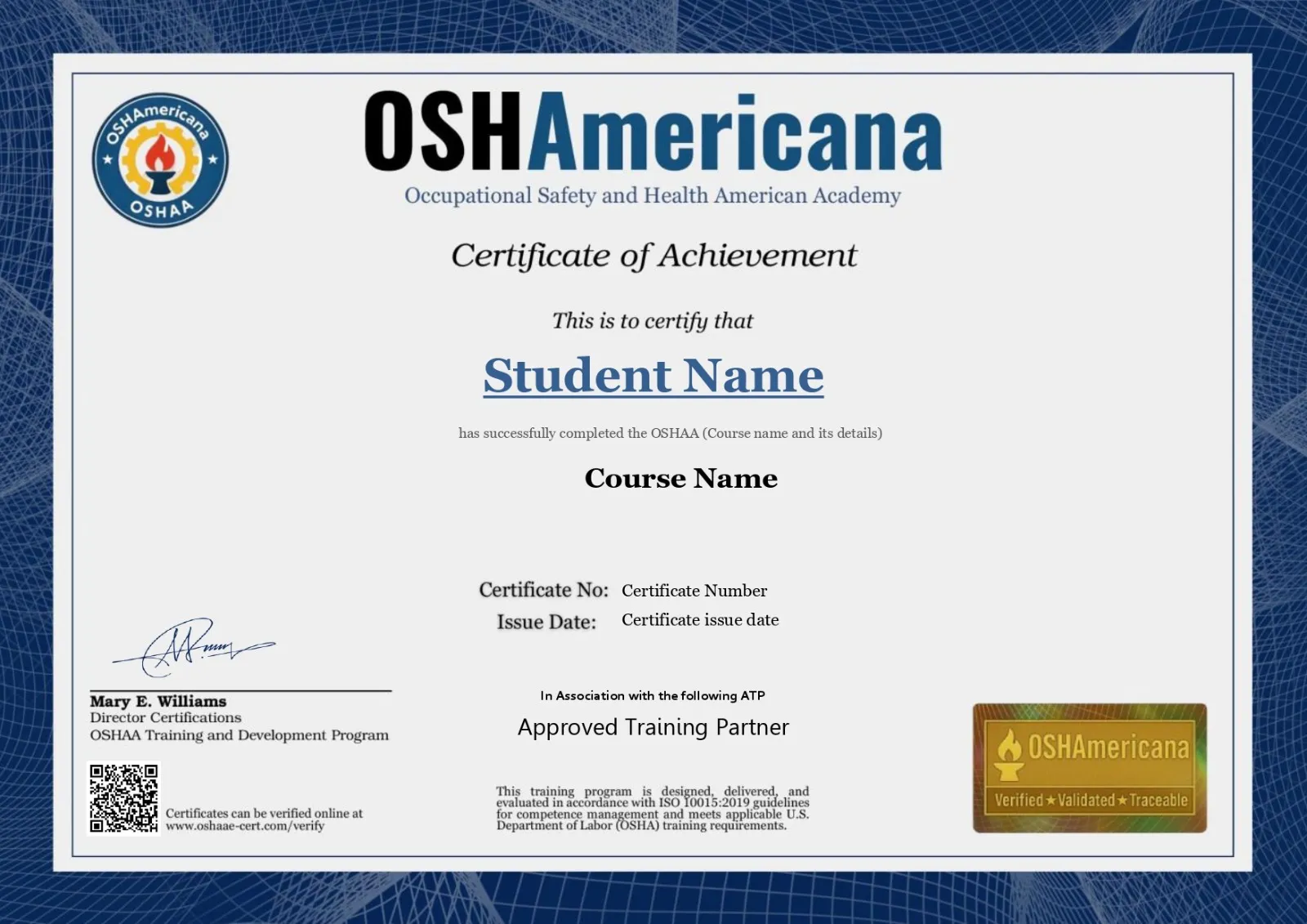
After completing the course requirements and achieving the required pass mark, successful learners receive an OSHAA OSHA 501 course certificate issued by the Occupational Safety and Health American Academy (OSHAA). Certificate details can be checked through the OSHAA verification service.
Benefits of the OSHAA OSHA 501 Course
The course combines general industry safety knowledge with communication and instructional development.
Develop General Industry Safety Knowledge
Build structured understanding of common workplace safety subjects and industrial hazards.
Strengthen Hazard Recognition
Improve awareness of electrical, chemical, machinery, ergonomic and occupational health hazards.
Understand Workplace Safety Practices
Explore walking-working surfaces, PPE, emergency arrangements and hazardous energy topics.
Improve Safety Communication
Develop ways to explain safety information clearly and appropriately to workplace audiences.
Build Instructional Skills
Practise organising subject matter, structuring presentations and engaging learners.
Support Workplace Learning
Develop knowledge that can contribute to safety awareness and workplace learning activities.
Career Opportunities and Relevant U.S. Job Roles
The course subject matter may be relevant to professionals involved in general industry safety, workplace training and industrial operations. Job requirements vary by employer, experience and other qualifications.
Safety Training Coordinator
Helps organise workplace safety learning, schedules, materials and training records.
General Industry Safety Specialist
Supports hazard awareness, workplace inspections and safety programme activities.
EHS Coordinator
Coordinates environmental, health and safety information and operational support.
Industrial Safety Supervisor
Supports safety communication and safe work practices across industrial teams.
Workplace Safety Instructor
Delivers workplace learning within the scope of their employer’s training programme and applicable requirements.
Safety Programme Assistant
Supports safety documentation, training activities and improvement initiatives.
Manufacturing Safety Coordinator
Supports safety activities in production, processing and manufacturing environments.
Safety Consultant Support
Assists with safety communication, learning resources and workplace safety projects.
Frequently Asked Questions About OSHA 501 – Trainer Course in Occupational Safety and Health Standards for General Industry
What is the OSHAA OSHA 501 Trainer Course?
It is an OSHAA course focused on general industry occupational safety and health topics, together with communication and instructional development. The curriculum is organised into 12 study units.
What topics are covered in the course?
The 12 units cover occupational safety and health principles, general industry safety topics, walking-working surfaces, fall protection, electrical safety, Hazard Communication, PPE, machine guarding, materials handling, fire protection, industrial health hazards, confined spaces, lockout/tagout and trainer development.
Who should enrol in this course?
The course is intended for experienced safety professionals, EHS personnel, supervisors, engineers, workplace trainers, operations managers, consultants and others involved in general industry safety activities.
What are the entry requirements?
The published course information recommends at least five years of relevant general industry or safety experience, working knowledge of workplace hazards, familiarity with risk management and sufficient English proficiency. Confirm any additional enrollment conditions with the selected OSHAA Approved Training Partner.
How many study units are included?
The course contains 12 study units covering general industry safety knowledge, workplace hazards and trainer-development topics.
How is the course assessed?
The published OSHAA assessment structure uses 100 multiple-choice questions. Learners must achieve a minimum score of 70% to pass.
How long does the course take?
A course duration is not specified in the information currently supplied for this page. Contact an OSHAA Approved Training Partner for the current schedule and expected study time.
Is the course available online?
Study formats and availability depend on the OSHAA Approved Training Partner. Contact the partner to confirm whether online, classroom or blended study is available.
Who issues the course certificate?
Successful learners who complete the course requirements and achieve the required assessment result receive an OSHAA course certificate.
How can I find an OSHAA Approved Training Partner?
Visit the OSHAA Approved Training Partner directory or email support@oshamericana.com for information about available training options.
How to Study the OSHAA OSHA 501 Course
Learners enrol through an OSHAA Approved Training Partner, which provides course delivery and learner support. Available study formats, schedules and fees are confirmed by the selected partner.
- 1
Find a Training Partner
Explore the OSHAA Approved Training Partner directory or contact OSHAA for assistance.
- 2
Confirm Enrollment
Check entry requirements, course fees, available study format and schedule with the partner.
- 3
Study the 12 Units
Work through the course topics and learning materials provided by your training partner.
- 4
Complete the Assessment
Attempt the 100-question MCQ assessment and achieve at least 70% to pass.
- 5
Receive Your OSHAA Certificate
Successful learners receive an OSHAA course certificate after meeting the course requirements.