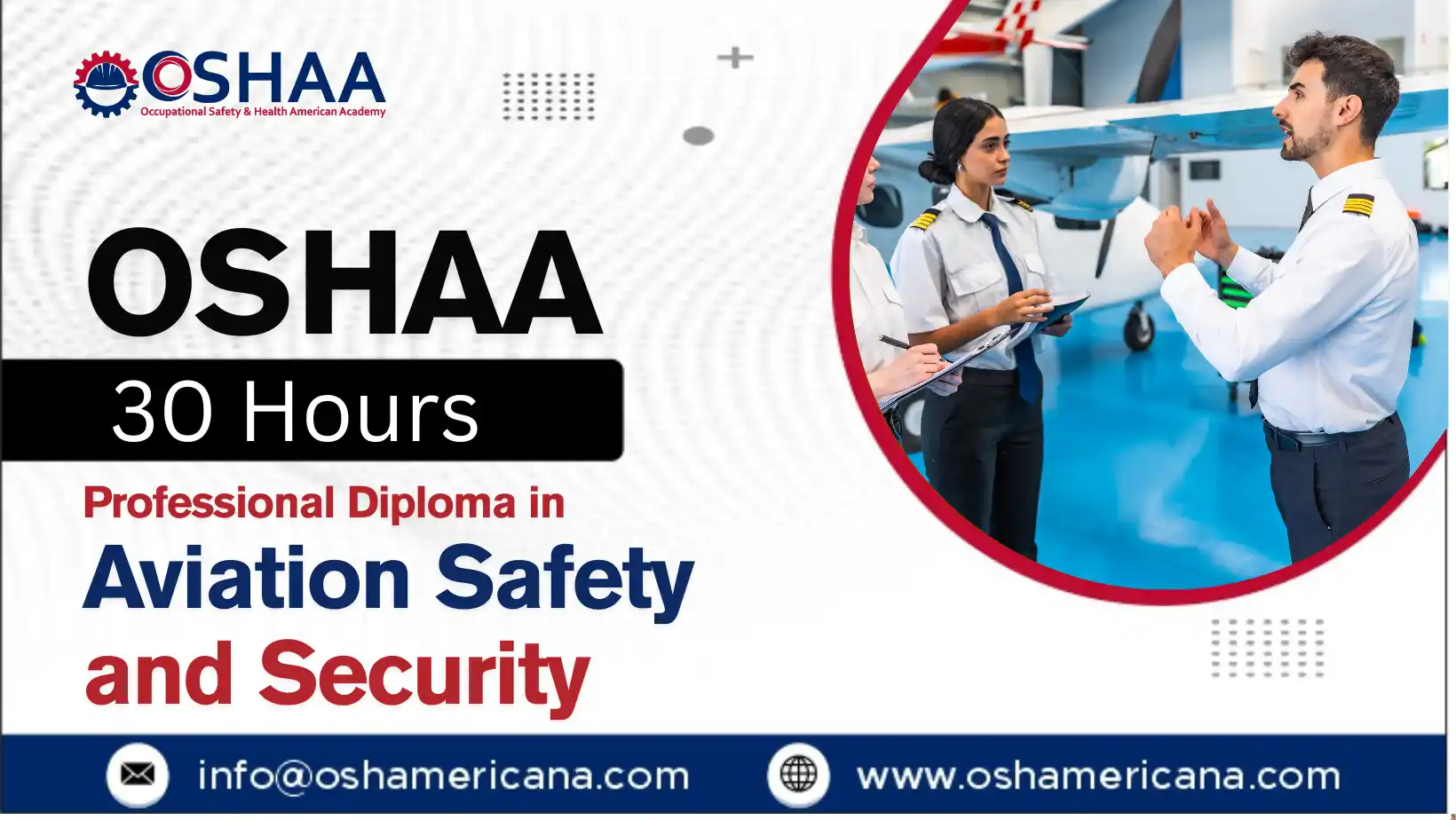
OSHAA 30-Hours Professional Diploma in Aviation Safety and Security
The OSHAA 30-Hours Professional Diploma in Aviation Safety and Security is a specialised professional course designed to develop learners’ knowledge of essential safety and security practices within the aviation industry. The programme provides an industry-focused understanding of aviation safety, security awareness, risk management, emergency preparedness, hazard identification, and procedures that support safe and secure airport and airline operations.
Aviation safety and security are critical to protecting passengers, employees, aircraft, airport facilities, cargo, and operational activities. This course helps learners understand how potential hazards and security risks can be identified, assessed, controlled, and managed within aviation environments. Learners can also develop awareness of emergency response, workplace safety, security procedures, communication, incident prevention, and the importance of following established aviation standards and operational procedures.
The 30-Hours Professional Diploma in Aviation Safety and Security is suitable for airport staff, airline employees, ground handling personnel, aviation security staff, safety officers, airport operations professionals, supervisors, and individuals seeking professional knowledge in aviation safety and security.
With a practical and accessible learning approach, the course supports learners in developing competencies relevant to modern aviation operations. It can help professionals strengthen their understanding of aviation risk management, promote safer working practices, and contribute to effective safety and security procedures across airports, airlines, ground operations, and other aviation-related workplaces.
OSHAA 30-Hours Professional Diploma in Aviation Safety and Security
To ensure participants can fully benefit from the programme and engage effectively with course content, the following entry requirements are recommended:
- Age Requirement: Applicants should be at least 18 years of age to ensure suitability for professional training within regulated aviation and safety environments.
- Educational Background: A minimum of secondary school education or equivalent is recommended. Learners with related diplomas or certificates in aviation studies, airport operations, occupational health and safety, security management, risk management, engineering, or transport management will find the course especially advantageous.
- Language Proficiency: Participants should have a basic to intermediate level of English proficiency, as training materials, assessments, and aviation safety terminology are delivered in English.
- Work Experience: Prior experience in aviation, safety, security, compliance, or operational roles is beneficial but not mandatory, making the programme suitable for both early-career professionals and experienced practitioners.
The OSHAA 30-Hours Professional Diploma in Aviation Safety and Security is designed to accommodate learners from diverse educational and professional backgrounds, providing a strong foundation for developing safety leadership and compliance expertise within the global aviation industry.
Study Units
Learning Outcomes
The Learning Outcomes of the OSHAA 30-Hours Professional Diploma in Aviation Safety and Security are designed to provide participants with advanced technical skills, compliance knowledge, and safety leadership abilities essential for success in the global aviation industry. This course equips learners with the expertise to manage aviation safety and security operations effectively, ensure adherence to OSHA and international aviation standards, and implement strategies that enhance both passenger protection and organizational resilience.
Introduction to Aviation Safety, Security, and Global Standards (3 Hours)
- Understand the global importance of aviation safety and security in protecting passengers, staff, and assets.
- Identify international safety and security standards and their role in shaping aviation operations.
- Demonstrate knowledge of how compliance frameworks integrate into aviation safety and security practices.
- Recognize the importance of aligning aviation operations with OSHA and ICAO standards.
Fundamentals of OSHA Regulations and International Aviation Compliance (3 Hours)
- Gain a comprehensive understanding of OSHA standards and their application in aviation safety and security.
- Interpret international aviation compliance requirements, including ICAO, IATA, and EASA guidelines.
- Apply occupational health and safety principles to aviation environments.
- Develop awareness of employer responsibilities, employee rights, and enforcement mechanisms.
Aviation Risk Management Principles and Safety Frameworks (3 Hours)
- Learn the fundamentals of aviation risk management and its role in operational safety.
- Apply risk management frameworks to identify, assess, and mitigate aviation hazards.
- Understand the integration of risk management into daily aviation operations.
- Develop strategies to enhance organizational resilience through proactive risk control.
Airport Security Operations, Passenger Screening, and Access Control (3 Hours)
- Master essential procedures for airport security operations and passenger screening.
- Apply access control measures to safeguard restricted areas and critical infrastructure.
- Understand the coordination required between airlines, airports, and regulatory authorities.
- Implement best practices for operational safety and compliance in airport security.
Hazard Identification, Threat Assessment, and Control Measures (3 Hours)
- Conduct systematic hazard identification in aviation and transport operations.
- Apply risk assessment methodologies to evaluate workplace and security threats.
- Develop control measures to mitigate risks and enhance operational safety.
- Integrate hazard prevention strategies into daily aviation workflows.
Safety Management Systems and Security Culture in Aviation (3 Hours)
- Understand the structure and function of Safety Management Systems (SMS) in aviation.
- Apply proactive safety management practices to reduce risks and incidents.
- Promote a positive workplace safety and security culture within aviation organizations.
- Integrate SMS into organizational operations for long-term compliance and safety.
Human Factors, Leadership, and Communication in Safety and Security (3 Hours)
- Recognize the role of human factors in aviation safety and security performance.
- Understand the impact of fatigue, stress, and communication on safety outcomes.
- Apply leadership strategies to encourage employee engagement in safety initiatives.
- Strengthen communication skills to improve safety culture and team performance.
Emergency Response Planning, Crisis Management, and Incident Handling (3 Hours)
- Understand the fundamentals of emergency response planning in aviation.
- Develop crisis management strategies for accidents, security threats, and natural disasters.
- Apply communication protocols during emergencies to ensure coordinated responses.
- Evaluate case studies of past incidents to strengthen preparedness and resilience.
Regulatory Audits, Compliance Monitoring, and Quality Assurance (3 Hours)
- Interpret international aviation compliance frameworks and oversight mechanisms.
- Apply compliance strategies to ensure adherence to safety and operational requirements.
- Understand the role of audits, inspections, and certifications in maintaining compliance.
- Develop strategies for continuous improvement in regulatory adherence and quality assurance.
Final Assessment, Case Studies, and Professional Applications (3 Hours)
- Demonstrate mastery of knowledge gained throughout the OSHAA 30-Hours Professional Diploma in Aviation Safety and Security.
- Apply theoretical knowledge to real-world case studies and operational scenarios.
- Develop problem-solving skills for complex safety, compliance, and security challenges.
- Showcase professional readiness to lead in aviation safety and regulatory compliance.
By completing the OSHAA 30-Hours Professional Diploma in Aviation Safety and Security, participants will be fully prepared to lead safety and security initiatives, ensure compliance with international standards, and foster a strong safety culture within aviation organizations.
The OSHAA 30-Hours Professional Diploma in Aviation Safety and Security is designed in line with OSHA-based safety principles and international aviation standards. It helps learners develop essential competencies in safety management, security awareness, and regulatory compliance required in the aviation industry.
Course Benefits:
- Global Career Relevance – Gain knowledge aligned with internationally recognized safety standards and practices
- Enhanced Safety Knowledge – Gain strong understanding of OSHA-based aviation safety standards and risk prevention practices
- Improved Security Skills – Learn aviation security procedures, threat identification, and passenger safety control
- Regulatory Compliance Awareness – Understand international aviation regulations and workplace safety requirements
- Emergency Preparedness Training – Develop the ability to respond effectively to aviation emergencies and critical incidents
- Career Advancement Opportunities – Strengthen your professional profile for roles in aviation safety and airport operations
- Practical Industry Skills – Apply theoretical knowledge to real-world aviation safety and security situations
- Professional Confidence – Build confidence to work in high-pressure, safety-critical aviation environments
The OSHAA 30-Hours Professional Diploma in Aviation Safety and Security is developed in accordance with OSHA-based safety principles and international aviation standards. It is suitable for individuals who want to build strong expertise in aviation safety, security procedures, and compliance management within airport and airline environments.
Target Audience:
- Professionals in transport sector wanting to upgrade their safety and security skills.
- Aspiring aviation professionals seeking a career in aviation safety and security
- Airport and airline staff members aiming to enhance safety compliance knowledge
- Aviation students looking for OSHA-aligned certification in safety and security
- Security personnel working in airport or airline operations
- Ground handling staff involved in passenger and baggage safety processes
- Emergency response trainees interested in aviation risk and crisis management