Master Piping Inspection Skills with QA/QC Professional Diploma
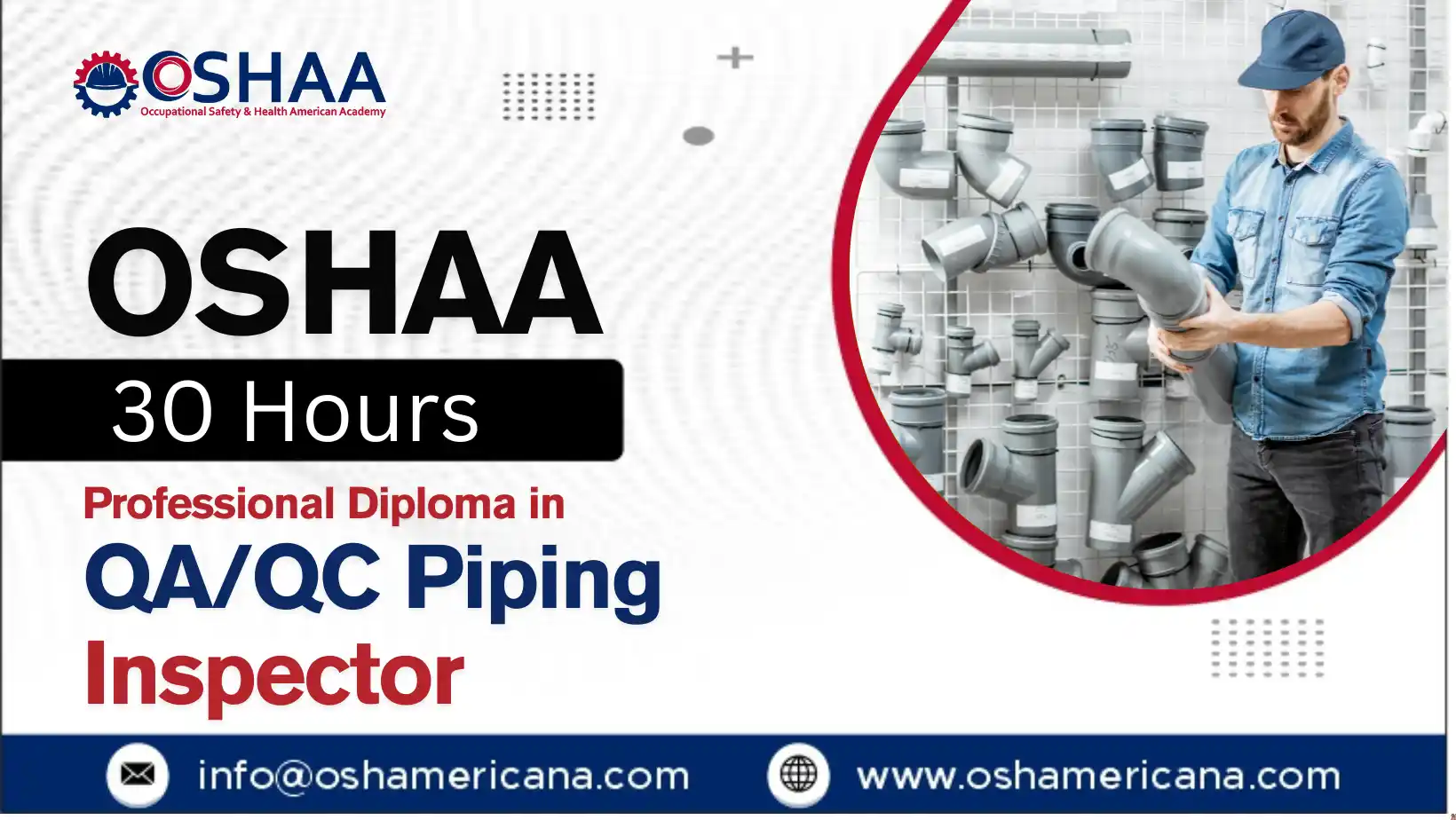
Quality control is essential to ensuring the safety, performance, and long-term reliability of piping systems across industrial projects. The OSHAA 30-Hours Professional Diploma in QA/QC Piping Inspector is a professionally structured qualification designed to develop the practical skills and technical knowledge required to perform piping inspection and quality control activities in accordance with international standards.
Awarded by OSHAA, this industry-focused diploma provides a strong foundation in QA/QC principles, inspection procedures, and quality documentation relevant to sectors such as oil and gas, petrochemicals, power generation, and large-scale construction. The course is designed to support both new entrants and experienced professionals seeking to strengthen their inspection capabilities.
Throughout the 30-hour programme, participants gain in-depth understanding of piping materials, fabrication methods, welding processes, and non-destructive testing concepts. Emphasis is placed on interpreting engineering drawings and piping isometrics, identifying fabrication and welding defects, and applying recognised codes such as ASME, API, and ISO during inspections.
The course also covers inspection and test plans (ITPs) and essential documentation, including welding procedure specifications, qualification records, and NDT reports. On completion, participants are well prepared to support quality inspections during fabrication, installation, and commissioning, contributing effectively to quality-driven industrial projects.
OSHAA 30-Hours Professional Diploma in QA/QC Piping Inspector
- Age: 18+ years
- Education: High school or equivalent; related diplomas/certificates in Mechanical Engineering, Welding, Piping, Fabrication, or Industrial Safety are advantageous
- Language: Basic English comprehension
- Experience: No prior experience required, though technical or industrial background is beneficial
Study Units
Learning Outcomes
Introduction to QA/QC in Piping Projects (2 Hours)
• Understand the fundamental concepts of quality assurance and quality control in piping projects
• Identify the key roles and responsibilities of a QA/QC piping inspector
• Recognise the importance of quality control in ensuring industrial safety, system performance, and regulatory compliance
Piping Materials, Components, and Fabrication Practices (5 Hours)
• Identify commonly used piping materials and understand their mechanical and chemical properties
• Understand selection criteria for pipes, fittings, flanges, and valves based on service conditions and standards
• Gain insight into typical fabrication practices and procedures applied in piping projects
International Standards and Codes: ASME, API, ISO (4 Hours)
• Develop working knowledge of widely applied international piping standards such as ASME, API, and ISO
• Interpret the application of codes during inspection, testing, and quality verification
• Understand the role of international standards in piping system design, documentation, and compliance
Welding Fundamentals and Visual Inspection (4 Hours)
• Understand basic welding processes commonly used in piping fabrication
• Learn the requirements of welding procedure specifications (WPS) and welder qualification
• Develop practical skills in visual inspection to identify surface defects and workmanship issues
Non-Destructive Testing (NDT) Methods and Applications (4 Hours)
• Understand the principles of common NDT methods including RT, UT, MT, and PT
• Learn how and when different NDT techniques are applied during inspection stages
• Interpret NDT reports and evaluate results against project and code requirements
Reading and Interpretation of Piping Isometrics and Layout Drawings (5 Hours)
• Gain confidence in reading and interpreting piping isometric drawings
• Identify key drawing elements such as symbols, elevations, weld locations, and line numbers
• Translate drawing information into practical field inspection activities
Inspection and Test Plans (ITPs) and Quality Control Procedures (3 Hours)
• Understand the structure, purpose, and importance of ITPs in QA/QC systems
• Learn how to plan inspections and verify compliance at various project stages
• Develop the ability to document, report, and track inspection results effectively
Fabrication and Erection Inspection Techniques (3 Hours)
• Apply practical inspection techniques during fabrication and erection of piping systems
• Identify critical inspection points for welds, joints, supports, and alignment
• Learn how to coordinate inspections with project teams to ensure quality compliancen accordance with safety and quality standards
The OSHAA 30-Hours Professional Diploma in QA/QC Piping Inspector is designed to provide learners with essential knowledge and practical skills to perform high-standard inspections in piping systems. This course equips professionals with the tools to ensure quality, safety, and compliance in industrial and construction projects.
- Master Piping Inspection Skills – Learn QA/QC standards, inspection techniques, and defect identification in piping systems.
- Enhance Safety and Compliance Knowledge – Understand industrial codes, regulations, and safety protocols for piping projects.
- Boost Career Opportunities – Valuable for QA/QC inspectors, engineers, supervisors, and industrial professionals.
- Develop Practical Expertise – Apply hands-on techniques for evaluating quality, structural integrity, and project reliability.
- Increase Professional Competence – Gain skills recognized in construction, oil & gas, petrochemical, and manufacturing sectors.
- Ensure Project Quality – Learn how to maintain high standards and prevent defects in piping systems.
- Receive Recognized Certification – Obtain a professional diploma validating your expertise in QA/QC piping inspection.
The OSHAA 30-Hours Professional Diploma in QA/QC Piping Inspector is ideal for professionals and learners seeking to strengthen their skills in piping inspection, quality assurance, and industrial compliance. It is perfect for those working in construction, oil & gas, and manufacturing sectors.
- Anyone seeking professional certification in QA/QC piping inspection to enhance career opportunities
- QA/QC inspectors and engineers aiming to improve technical inspection and quality control expertise
- Piping and welding supervisors responsible for project safety and compliance
- Industrial professionals in construction, petrochemical, oil & gas, or manufacturing industries
- Project managers and site engineers needing knowledge of QA/QC standards and inspection procedures
- Maintenance and safety officers monitoring structural integrity and adherence to industry regulations
- Students and trainees pursuing careers in piping engineering, welding, or industrial quality control